
This page is for those who have participated in Dr Kate’s University of Plymouth presentation relating to hypnosis in extreme environments.
These videos support the content of the presentation and are intended for illustrative purposes, rather than delivering education in technical skills.
For any healthcare professional, clinical hypnosis, and the use of hypnotherapy techniques, can offer a wealth of resources for use in the field, whatever your extreme environment, together with working with outpatients and inpatients.
Training in rapid medical hypnosis can help you enhance the patient experience, as well as helping staff to deliver the treatment necessary for the patient.
You are invited to download the handout that accompanied the presentation, by following the QR code below.
The key topics of the presentation included:
Positive and Directional Language (PADLE)
PADLE enhances communication, and particularly the clarity and meaning of the communication message.
Everyday conversation, PADLE is focused on what is wanted e.g. Keep calm, rather than what isn’t wanted (e.g. Don’t worry).
Consideration is given to the Rules of the Mind, and having an understanding of how the mind tends to respond. For example, if the intellect and the imagination are in conflict, the imagination will tend to win.
The presentation gave examples, from the research of Tom Rath, that positive communication is more productive.
In contrast, negatively focused language, such as, “You can’t be late for the meeting” focuses the listener on what isn’t desired.
Key words to avoid include: Don’t, Try, Should, Mustn’t.
What hypnosis is, and isn’t!
The vast number of myths and misconceptions about hypnosis, such as ‘mind control’, commonly arise from the media, movies and books.
A wide range of hypnotic phenomena can be suggested, including suggestions relating to movement, time, memory and sensory changes.
Suggestion can be either ‘direct’ which are clear and unambiguous, and somewhat commanding, or they can be indirect, giving the illusion of choice. Metaphors (hypnotic stories) also come into this category.
Conversational hypnosis
Conversational hypnosis is focused on achieving a particular outcome e.g. promoting relaxation during a procedure. The hypnotic interaction will occur within conversation, rather than following a specific eyes closed hypnotic induction and deepener.
Understanding a patient’s Locus of Control and Sensory Preference will help you deliver you conversational hypnosis suggestions in a way that best suits their needs.
Direct hypnosis suggestions
These are often connected to a known action. For example, “When your head hits the pillow, you will fall into a deep and restful sleep”.
Indirect suggestions
These included:
Imagination – What will it be like when….?”
Permissiveness – “Maybe, you could, you might…”
Double binds – “Would you prefer to X or to Y?”
Presuppositions – “As soon as you X, you will Y”
Abstracts – “Some people will…”
Negatives – “Do’t relax too quickly.”
Embedded suggestion, “I wonder if you can relax deeply now?”
Formal hypnosis
We tend to get patients to close their eyes for formal hypnosis. About 70% of cognitive input comes from the vision. Closing eyes means that a person is better able to focus on their inner world.
A range of hypnotherapy approaches can be used for symptom management and changework. Four key areas for work are:
1. Behavioural – focused on changing habits and actions, together with engaging psychoneuroimmunology (PNI)
2. Cognitive – working with limiting thoughts and beliefs
3. Analytical – gaining insight
4. Regression – gaining perspective
‘Eyes closed’ formal hypnosis work tends to have a specific range of components.
It would seem unlikely that you will be engaging in full therapy sessions half-way up, or down, a mountain. However, the structure of formal hypnosis is worth observing.
Focus on pain management
When working with pain management, a blend of conversational and formal hypnosis can be really helpful.
As explored during the presentation, there is clear research evidence to support the use of hypnosis to alter the patient’s experience.
The eye roll induction (see video below) is popular for creating the state of hypnosis.
This can be followed by a simple countdown deepener, such as:
I will count down from 10 to 1. With each count, you will go deeper into hypnosis as you focus on my voice, and my voice only… 10…9…8…7…6…5…4…3…2…1…
At the end of any formal hypnosis work, you would deliver a re-alerting process. This offers a count (usually from 1 to 5), with suggestions that all normal healthy sensations were resumed, and that the participant will feel refreshed and alert when they open their eyes
Here are some examples of the hypnosis techniques that I teach during my workshop, together with others which you may find useful.
Here are some examples of the hypnosis techniques that I teach during my workshop, together with others which you may find useful.
Look up at your eyebrows, now up through the top of your head
-While still looking up… slowly close your eyes
-While still looking up…take a deep breath
-Relax your eyes when you breathe out
Here are some examples of the hypnosis techniques that I teach during my workshop, together with others which you may find useful.
Blogs
We have a wide range of hypnosis and hypnotherapy blogs that you can access here.
More videos
We also have a YouTube channel which has lots of relevant videos. You can find that here.
We regularly run entry-level training and you can find out more about our upcoming Learn How to Hypnotise workshop here.
I’m a highly experienced hypnotherapy trainer, who teaches a broad range of healthcare professionals and presents on the use of medical and clinical hypnosis. This recently included teaching at the World Extreme Medicine Conference. To find out more about my hypnotherapy training options, click here.
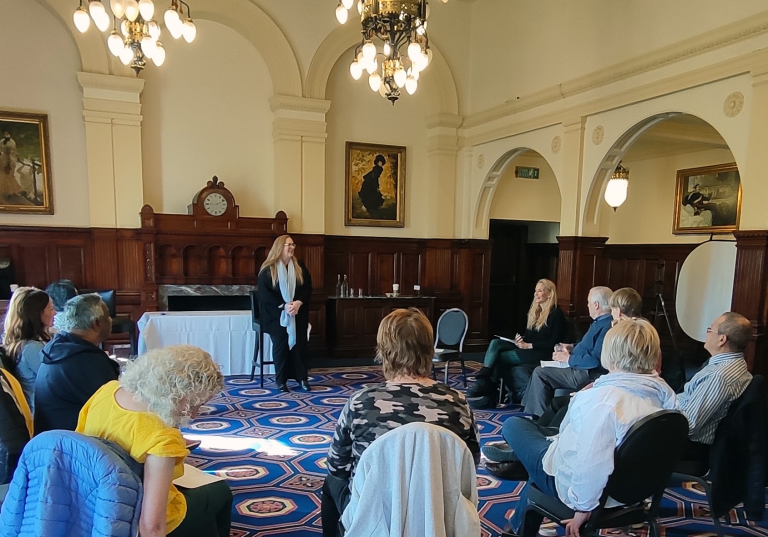
Here you can find out more about my hypnosis and hypnotherapy background, together with events that I will be attending (and have attended), and books that I have written.
If I have a guilty pleasure, it’s writing books! So far, I have written five hypno books, co-written another and even created some additional hypno products. Full details about all of these are available on our reading list.

You are invited to explore our hypnosis resources:
You may also like to connect via social media and join our mailing list:

If you would like to find out more about any of our hypnotherapy training for healthcare professionals, or would like to talk about booking some training for yourself or a team, then please contact Dr Kate.